How to be disgustingly specific with your ideas?
On a sweltering summer day, a fox was walking through an orchard, just passing a grapevine.
The fox was thirsty.
It was just what he needed.
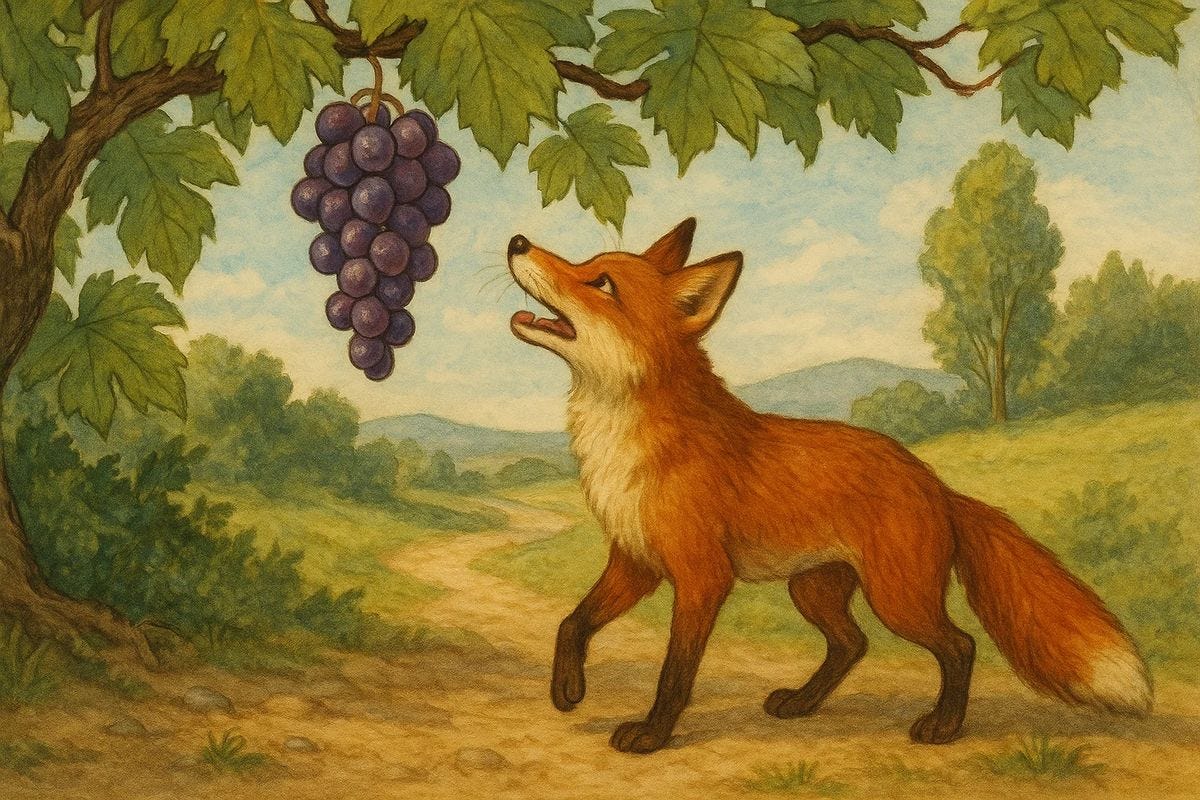
He took a shot, ran, and jumped at the grapes, missing them. Turning around, doing hoops around the grapevine, he tried again and again until he gave up.
While we walked away from the grapevine, he said, “I’m sure they are sour”.
This Aesop fable still stands as a point of reference whenever we want to emphasize that an envious someone hates what they can’t get.
Other fables of his writing are: “The Tortoise and the Hare,” “The Boy Who Cried Wolf,” “The Goose That Laid the Golden Eggs,” “The Wolf in Sheep’s Clothing.”
But the one that everyone knows is the one with the fox and the grapes.
Why?
I say it’s because it is the most specific. You instantly understand what the fable means, and it sticks in your mind because of the simplicity of the example.
A simple thirsty fox, hating on some grapes, rather than someone trying to explain an abstract concept about psychology.
Aesop was illustrating a universal human shortcoming.
If he thought to expose truths through “Aesop’s Helpful Suggestions – Learn how to lose, don’t be envious”, it wouldn’t have lasted a week.
I was instantly curious about how to learn from this and apply it to your copywriting and creative strategy.
What makes something disgustingly specific?
When I explain this to someone, I say, imagine what you can taste with your tongue, feel with your skin, hear with your ears, or see with your own eyes.
It’s all about senses and how it creates a lock in your memory.

In the book Made to Stick, it says that an “A V8 engine is concrete. “High performance” is abstract.
Most of the time, concreteness boils down to specific people doing specific things.“
For example, Nordstrom’s world-class customer service.
They wanted to be the company that offered disgustingly good customer service, out of this world. Something no other company would ever do.
To give you context, Nordstrom is an expensive department store.
Yet many people are willing to pay these higher prices because shopping at Nordstrom makes you feel seen, valued, and high-end.
But for their strategy to work, and for management to explain that to the people coming in for a job, they had to change a known “schema” in their minds.
People knew that customer service meant smiling at people and waving goodbye (more or less). And not wasting your time with people who don’t buy.
But here Nordstrom’s promise was exquisite customer service at the expense of efficiency.
So they told their employees these stories, to make them understand the level that is required of them:
– the Nordie ironing a customer’s shirt is disgustingly specific and out of the ordinary
– the Nordie who warmed customers’ cars in winter while they finished shopping
– the Nordie who made a last-minute delivery of party clothes to a frantic hostess
All unheard of.
These stories were valuable because they were unexpected, and not only that, but they were in alignment with Nordstrom’s brand promise.
These stories could just as easily be destructive in another context.
The 7-Eleven management definitely would not want this strategy, because it doesn’t align with anything they are.
This is a perfect example of how management taught their employees what customer service is, without abstract concepts.
Concrete language helps people, especially novices, understand new concepts.
The Nature Conservancy study
“The Nature Conservancy (TNC) has helped protect environmentally precious areas in the world using the simplest possible method: It buys them.” – Made To Stick
Another great example for specificity.
TNC bought land at market prices, protecting it from environmental damage, such as development or logging.
Their strategy was called “bucks and acres”
It was appealing to donors who supported TNC and made it possible because of a simple idea.
They could see where their money went.
It was concrete.
They said these were “results you could walk around on”.
In 2002, they faced a challenge. California became particularly important for them, as it contained so many critical areas.
It is one of only five Mediterranean climate regions in the world.
Even though these climate zones occupy 2% of the world’s landmass, host more than 20% of plant species.
When they sat down and mapped the areas worth preserving, 40% of the map was colored. It was hard to get that much money, yet 9% of the state was in “critical danger”.
So, naturally, TNC couldn’t just give up on the idea, but they were aware that “bucks and acres” wouldn’t fall in line with this vast land.
If they couldn’t buy it, they thought they would pay landowners not to develop their land, buying what’s known as a conservation easement.
They had to work with local and state governments to change policies and encourage conservation of public and private land, and marine areas where there was no land to buy.
The first ones affected by this change in strategy were their employers. Before, they used to celebrate closing a deal and selling a piece of land.
Now, it was more complicated than that. More bureaucracy and less tangible results.
Acreage was not the best way or wording for it, because people couldn’t imagine “acreage”.
It’s vague.
So what did they do?
Keep reading for free where this article was originally posted.